Why reading and writing is the road to happiness...


This blog started years ago as a place to muse on the life projects keeping me entertained. It is no surprise then that it has morphed into a blog about my reading as that has been my lifelong project. Here I review lots of different types of books, with an added focus on Australian women writers. Hope you enjoy - feel free to contribute to the conversation!

Tuesday, 8 July 2014

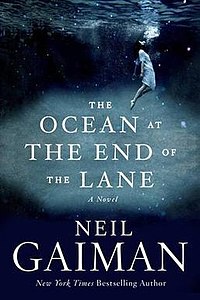
Book Review: 'The Ocean At The End Of The Lane' by Neil Gaiman

Ocean at the End of the Lane US Cover.jpg
It says much about Neil Gaiman’s writing that the first night I read 50 pages of his 2013 novel ‘The Ocean at the End Of the Lane’, I had a nightmare about a half man, half lizard repeatedly attacking me. No – there isn’t a lizard man in Gaiman’s novel but it certainly has some creepy characters and a chilling atmosphere. Gaiman is well known for creating other worlds that are unsettling, particularly in that they are inverting the concepts of our own world. Much of his work is seen through the eyes of a child protagonist or narrator, but the novels don’t feel like they are written for children or young adults. In this best-selling novel, the narrator is unnamed: a man who has come back to his childhood home for a funeral, and takes us back with him in time to age seven to remember the strange events that took place. The narrator lived on a rambling estate with his parents and his younger sister, who were completely normal. In this Gaiman novel, unlike his other best-seller Coraline where the parents were monsters, it is the neighbours and his new nanny who are the unusual element. On a farm next to the narrator’s home, three females (the Hempstocks) welcome him into their lives: young Lettie, eleven years old, and two older ladies who appear to be her mother and grandmother. The Hempstocks are soon revealed to possess strange abilities to transverse space and time: the narrator is taken into what seems another dimension by holding Lettie’s hand, and happens to pull back with him the monster of Ursula who becomes his nanny. Writing a synopsis of the novel makes it seem very simple, but it’s Gaiman’s imagination, and ability to create unsettling tension that makes his writing so popular, and evocative. And while the images are nightmarish, the characters have a quaintness that relieves the reader from the heavier material. The Hempstocks with their old style, rustic goodness are beautifully drawn, and the reader is made to feel as safe as the narrator when in their company. Lettie in particular with her adult wisdom is a charming character:
“Oh, monsters are scared," said Lettie. "That's why they're monsters. And as for grown-ups...' She stopped talking, rubbed her freckled nose with a finger. Then, 'I'm going to tell you something important. Grown-ups don't look like grown-ups on the inside either. Outside, they're big and thoughtless and they always know what they're doing. Inside, they look just like they always have. Like they did when they were your age. Truth is, there aren't any grown-ups. Not one, in the whole wide world.””
Likewise to Lettie’s wise adult voice, the narrator’s adult-remembering-childhood perspective is melancholic and insightful: “I do not miss childhood, but I miss the way I took pleasure in small things, even as greater things crumbled.”
To analyse this short novel any further would give too much away, but I would recommend dipping into Gaiman’s imaginary world: beware dreaming of lizard men at your own peril.

Monday, 23 June 2014

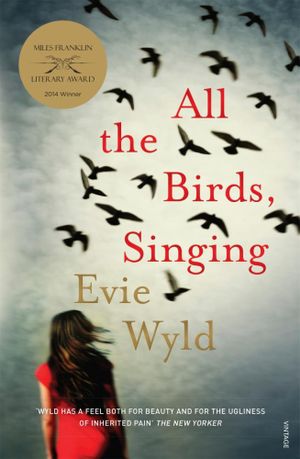
Book Review - 'All The Birds, Singing' by Evie Wyld

All the Birds Singing : Longlisted for the 2014 Miles Franklin Award - Evie Wyld
'All The Birds, Singing' is a very interesting novel. I finished reading it last night and immediately googled 'what happens at the end of all the birds singing' so that gives you an indication of the resolution of the novel. Turns out I'm not as stupid as I thought and the novel ends with some mysteries left unresolved but that does not detract from Wyld's text. It's a mesmerising read. The sinister feel of the novel is created through the dual setting of outback Australia and rural England: despite the birds in the title, it is sheep that dominate the story and descriptions of them dying complement the hard reality of farming life:
'Another sheep, mangled and bled out, her innards not yet crusting and the vapours rising from her like steamed pudding'.
The protagonist, Jake Whyte, is a hard woman to match the hard life of farming and shearing. She has a man's name, lives in a man's world, and descriptions of her strong arms and strong countenance make her an intriguing character: 'It's too hot, but I like the way the heat makes my arms feel like they're full of warm oil, and sweat runs down them in sheets soaking the sides of my singlet'. The unusual portrayal of a female shearer is attractive, and the references to Jake by other characters as a 'bloke' is nicely ambiguous.
The first third of the novel is full of pauses and threads hanging without elaboration, but as the rest of the novel unfolds we are given the full story of Jake's life and it isn't pretty. Wyld's descriptions of sex aren't gratuituous but are confronting, and if we are led to believe that the shearing shed can be a woman's world, we are under no illusion that for desperate young women trying to eke out a living, it is still a man's world: 'And as it goes, the sex is just the same for bored men as it is for over-excited men. I guess they've had the chance to really think about the things they'd like to do to a person'.
Jake dominates the novel, but secondary characters are given brief but engaging cameos: her teenaged friend Karen is a wonderfully eccentric buddy in Port Hedland, Don is a kindly farming neighbour, and Lloyd is a peculiar visitor to the farm, bringing with him kindness and a wry sense of humour. I wish there had been more of Lloyd in the book: he was the only lack of elaboration that disappointed me.
Evie Wyld was on the 2013 Granta list of Best Young British Novelists and this is no surprise given the sophistication of the ideas and imagery in this novel. Her residency in England may be assured now from her overseas success but I hope she travels back home to Australia more to write: she has a clever insight into the ugly beauty of our outback and the people who survive within it.

*This review is part of the Australian Womens Writers Challenge 2014


http://auswomenwriters.files.wordpress.com/2013/12/awwbadge_2014.jpg

Wednesday, 18 June 2014

Book Review - 'An Elegant Young Man' by Luke Carman


<p></p>Luke Carman’s 2013 short novel ‘An Elegant Young Man’ is a dark, witty, honest portrayal of a young man’s life growing up in Western Sydney. Whether this is actually Carman’s own story or only influenced by is irrelevant: the short pieces which form snapshots of a character’s time as child, teen, twenty something and thirty something, are realistic enough to be true, and / or interesting enough to also be fiction. The blurb of the novella claims that Carman ‘tells how it is on Australia’s cultural frontier’, Western Sydney. I don’t know if Liverpool truly is a cultural frontier but certainly the West has been a part of Sydney that has been largely ignored by literature, and subsequently I found ‘An Elegant Young Man’ original and engaging.
Carman’s dark sense of humour really delighted me. I loved the passages about the character Luke’s father. The gruff man’s commentary on his son’s and the neighbourhood friends’ Christmas play was sweet: ‘a plague on both our houses’. Carman’s description of Luke’s childhood friend Arnold was also sweet, a chubby and earnest Fijian boy, and his younger brother, a shy and silent boy: ‘Adam ate in a trance, lost in his inner world, the idyllic daydream of youth was always around him like a nakedness in the decline of our little mountain’.
Carman often describes ugly scenes, realistic portrayals of flabby bodies, worn out old faces, and sneering boys hanging around kebab shops: however, his writing is often beautiful, even describing the grim world of Cronulla’s main strip at peak drinking hour, ‘the smell of their sweat and aftershave and the product in their hair that gave them all spikes pushed out at the girls who gave soft cheeked smiles and eyeliner glances’. Often his language is reminiscent of the short, sharp dialogue of a noir thriller, ‘For a man like me, that was too much of a woman, and I didn’t ever want any more’ and this is in keeping with the swagger of the main character and the world he inhabits. And sometimes the imagery made me smile wryly such as the vividly disgusting description of the smell of a wrestling opponent’s arm pit as ‘like the interior of a Christmas ham-bag’.
My favourite pieces were about the character Luke’s time in the inner West, feeling like an imposter amongst the too-cool-for-school university set. Carman wonderfully sets up the story of his mate Brent through an urban style legend amongst the Newtown crowd, and it’s a lovely piece. I would like to think Brent was a real person: he sounds charmingly droll, ‘He looked into the colourful heap of confectionary and then into my eyes and said “I don’t want your chocolate. My guess is: nobody here does,” and he pushed past me and into the crowd’. Another piece about a girl, Nell, who holds poetry recitals in her Newtown terrace, is also a charming passage: ‘Nell looked deflated and shaken. I wondered if she was thinking how unfair the world is for a woman from the North Shore who believes in poetry and wants to get up on a stage and not be pressed and flattened into a fixture or a faucet of someone else’s machine, and y’know I would have cried for her’.
Carman references his teenage love of Henry Rollins, and the day at school after September 11, and the impact of WWF wrestling on his peer group in western Sydney. He covers a wide range of material in a short text. However, the most lingering piece for me was the third part of his chapter ‘Rare Birds’ where he describes the tumultuous relationship with Louise, ‘a sad-eyed girl with pale skin and black hair that hung to her elbows’. The piece, which follows a road trip that tore the two apart, didn’t echo any part of a relationship that I had experienced, and yet it still felt like a universal experience.
I hope Carman writes more material based in Sydney: he understands it, and has illuminated some interesting pockets of the population and landscape. I’d also like to think that he would be reassured by my admission that it was not only people from the Western suburbs who felt like imposters at the inner west University parties – I’m fairly certain only kids born and bred in Enmore and Newtown ever felt completely entitled to be there.

Book Review - 'The Poet's Wife' by Mandy Sayer


The Poet's WifeI felt a number of things after finishing Mandy Sayer’s new memoir ‘The Poet’s Wife’. I felt relief that she had finally decided to leave her first husband, Yusef Komunyakaa: description after description of his brooding, sulking tantrums nearly tipped me over the edge. I also felt envious of Sayer’s fascinating life: living overseas, writing, busking, meeting interesting people, living in a fabulous sounding apartment in Kings Cross. The memoir made me want to start house-hunting for a little studio of my own on Macleay Street. And finally, I felt that even though I was reading about a fair chunk of Sayer’s life, I was still interested enough in going back to read her first memoir ‘Dreamtime Alice’, the debut which put her on the literary map and which I have been told by friends is a cracking read.
Sayer is an engaging writer but I think what has made her a literary success is just how interesting she is as a person. Even an amateur writer could make something of Sayer’s early life: she was busking as a tap dancer, resplendent in top hat and tails, and living hand to mouth in New Orleans in the eighties.  That’s always going to be interesting. Her entrance into Komunyakaa’s studio, on roller skates, is like a scene from a David O. Russell film:
‘I glided across and came to a stop only inches short of him. He looked down at the skates, then back up at me. At first, I thought he might disapprove of my entrance, think it childish or even dangerous, but then he smiled and rested his hand on my shoulder, murmuring, Good to see you again. I inhaled the scent of his sweat – earthy, like mud – and had a sudden urge to kiss him.’
The fact that Komunyakaa was much older than Sayer, as well as African American, and a Pulitzer prize winning poet, gave Sayer plenty of material to explore within the memoir. But it was the jealous nature of Komunyakaa that became the constant motif of the text, and the ultimate problem in their relationship:
‘Sitting in his kitchen, hearing these anecdotes, I found myself even more in awe of him. He seemed so gentle and graceful – his poetry so lyrical – and I found it hard to reconcile this soft-spoken writer with a war-scarred ex-soldier ready to shoot his cheating girlfriend and all her lovers.’
I don’t know if I’d be alone as a reader of this text in feeling frustrated by the many years of Sayer’s tip toeing around Komunyakaa’s childish behaviour, but her eventual breakdown towards the end of the marriage is affecting, and I ultimately felt sympathetic for her plight:
‘I began writing suicide notes in Spanish, and kept them in my journal. Just describing my thoughts made me feel better, like slowly sucking venom from a snakebite. I knew Yusef read my journal when I wasn’t around – I always double checked the position of the book before leaving the house and then again on my return.’
The moments of writing I enjoyed most were the passages on her time in Kings Cross: Sayer is known for her love of the area, and she portrays the suburb vividly and fondly, without glamorising it:
‘As a kid I’d lived in the Cross for two years, and had returned with my father when we’d first begun busking. Now, in the mid-eighties, it was still an unruly village of corruption and vice: drugs, porn and sex could be procured as easily as a kebab or a beer.’
And I loved all the descriptions of her wonderful busking performances:
‘I set up my gear, tied on my shoes, and pressed play on the cassette player. As Yusef sheltered beneath an adjacent awning, I began dancing to a solo piano version of ‘Sunny Side of the Street’, tapping over the wet bricks, doing my best impersonation of Gene Kelly performing ‘Singin’ In The Rain’, swinging myself around a lamppost, jumping on the park bench, pirouetting from one side of the corner to the other’.
Like many memoirs of a full life, ‘The Poet’s Wife’ could have been slightly shorter – much time was spent describing writing courses in various universities, which became a bit repetitive. However, this is a memoir worth reading, less for the marriage that it explores, but more for the fascinating woman it dissects.

*This review is part of the Australian Womens Writers Challenge 2014


http://auswomenwriters.files.wordpress.com/2013/12/awwbadge_2014.jpg

Tuesday, 17 June 2014

Book Review: 'The Mistake' by Wendy James


Wendy James’ 2012 novel ‘The Mistake’ was a slow burner for me. The first few chapters, setting up the mystery of prim and proper Stepford wife Jodie Garrow and her missing baby, seemed slightly clichéd to me and the writing, at first, rather perfunctory. But as the plot developed, not only was I interested in what indeed had happened to the baby the teenaged Jodie had given away for adoption, I also really began to care for the characters. This was due entirely to James’ insightful portrait of the Garrow family. I knew James had been reviewed well for her other novels, and she had won the Ned Kelly award for her debut novel, so I was interested enough to continue past the initial chapters. What impressed me most was the believable portrayal of Jodie: she was a teenager from the wrong side of town, clever and determined to claw her way out of her dismal upbringing. The story of her rise out of working class misery to her position as attractive, well-to-do mother in small town NSW (no doubt based on Armidale, where James’ bio says she resides), was realistically and sympathetically told.
As a 1970s child of a teenage mother, I reflected on my own mother’s experience, as James described the fear and resistance of the 19 year old Jodie after the birth of her daughter:
‘No. Please.’ Jodie’s voice is sharp with panic. ‘Don’t you understand? I don’t need to see her. I don’t want to see her. I don’t want to touch her. I want her – I want her gone. Oh, God.’ She turns away, closes her suddenly stinging eyes. ‘Isn’t there someone who can make it all go away? This is like some sort of crazy nightmare.’ Then, like the child that she is: ‘I wish I was dead’.
Her child-like rationale, no doubt influenced as well by her lack of worldliness, meant that Jodie saw nothing troubling about the hospital matron’s suggestion that the child be ‘given’ to a couple who were having trouble adopting. The reader is immediately alarmed; the novel then moves back and forth in time adding details to the puzzle of the whereabouts of that child some twenty years later. The ultimate picture that we are given of Jodie is complex, sympathetic, and quite haunting. I thought the description of Jodie obsessively reading social media commentary of her alleged ‘crime’ particularly moving, and it did cause me to stop and think about the treatment of victims and alleged perpetrators in real life crimes.
Secondary storylines involve Jodie’s very nicely drawn teenage daughter, who became more and more nuanced as the novel developed:
‘Hannah feels irritation flare, unaccountably maddened by her mother’s meek obedience, her passivity. Why won’t she do the talking? If it’s her story, why not tell it herself, her own way?’
And Jodie’s lawyer husband Angus is given some insightful moments that balance out a more traditional portrayal of the philandering husband:
‘The truth is that Angus doesn’t know the full story either. And one part of him – the cool, disinterested lawyer side of him, the aspect that, as the years pass, as his work becomes almost a second skin, has begun to define him – that part of him doesn’t want to know the full story, is warning him to proceed with caution.’
I enjoyed this novel and was quite affected by the resolution of the story. I’ll be going back for more of James’ work, in particular her latest ‘The Lost Girls’ which piqued my interest after reading recent reviews.

*This review is part of the Australian Womens Writers Challenge 2014


http://auswomenwriters.files.wordpress.com/2013/12/awwbadge_2014.jpg

Monday, 26 May 2014

Book Review: 'The Women In Black' by Madeleine St John


Stjohn-cover-3d_detailWhat a fascinating novel 'The Women in Black' turned out to be - and with an even more fascinating back story to its author. I was aware of the Text Publishing reprinting of Australian classics and had read reviews of Madeleine St John’s 1993 novel when it was re-released – but it took me a while to get to read this little gem. The introduction alone is worth reading. Written by St John’s old Sydney Uni classmate Bruce Beresford, it gives an insight into those halcyon days of my old alumni; St John and Beresford studied with Germaine Greer, Clive James and Robert Hughes, among others. Beresford described the North Shore girl as quirky and full of interesting energy: “Tiny and with rusty-red hair, she always reminded me of a sparrow with her darting movements, her beak-like nose, her inquisitive eyes.’ St John eventually lived in London and latish in life, wrote four novels, of which ‘The Women in Black’ was critically well received and a hit with readers. She was an eccentric by all description and sounded thoroughly charming.
The novel, at its superficial level, is very sweet. The characters are treated with absolute tenderness, and the end note is positive and generous towards the women at its centre. At a deeper level, the novel is a dig at the mores of 1950s Australia, especially issues of women and education, career and marriage. The plot is centred on a small group of women working in what is clearly David Jones in Elizabeth St, Sydney. As a veteran of Myers and David Jones, in my university days, I loved the satirical analysis of the division between the departments: the always snooty designer ware, the dolled up perfume counter girls, the worker bees in the less glamorous departments. Nothing has changed. The main character Leslie, or Lisa, as she has decided to call herself – a much more sophisticated name – has taken a summer job at the department store. And we see metamorphosis beyond the name change. Lisa is clever, but fairly plain and unworldly. As St John notes of Lisa’s school days: “Her only cronies seemed to be two other girls similarly outside fashion: a very fat girl and another who suffered from eczema: girls for whom there seemed everything to be done, but nothing which might be: girls who must find their way through the maze as best they might.”
Lisa’s world is opened up when she is taken under Magda’s wing: Magda is a ‘continental’, Hungarian, and works in the designer gowns section. She likes Lisa, sees she is clever and starts a makeover, both dressing Lisa up but also introducing her to the ‘migrant’ experience. At a party held in Magda’s fabulous Elizabeth Bay apartment, she is generous in her gregarious European way, so foreign to the three veg and meat Lisa: “’Now for some food’, she cried, rubbing her hands together as she approached the table. ‘What has he bought for us? Come Lisa and sit, and help yourself please. I will cut some bread. Do you like rye bread? This is very good. Then you have what you like with it, cheese – various kinds all here on this plate, ham yes, liverwurst, that sausage is good or try this salami, then I see he has made us a salad as well – you must eat some of that, it is good for you. Stefan, pour me a glass of wine, I beg you’.
The crux of Lisa’s story is her hope to persuade her father to allow her to go to University. Her working class parents are a metaphoric picture of the evolving women’s movement in Australia: her father thinks going to uni will make Lisa ‘get ahead of herself’ but her mother is blissfully proud of her ‘scholar’ daughter, and sees her daughter’s achievements as the fulfillment of lost dreams. However, Lisa’s entrance to uni rests on her father’s signature on the enrolment form. She is powerless to make her own decision. St John’s novel is a reminder of how far we have come in so little time.
The secondary characters, Patty and Fay, have more prosaic futures but also illustrate interesting dilemmas for the sixties. Fay is almost ‘on the shelf’ in her thirties, and St John (herself unmarried) paints an insightful and poignant picture of a girl making mistakes over and over again: “Fay’s heart sank. She had been meeting these men, or others resembling them in every important particular, throughout her adult life. She had eaten their dinners, drunk gin-and-limes at their expense, and she had danced in their arms; she had fought off, and sometimes submitted to, their love making. She had travelled this particular road to its bitter and now dusty end and her heart now failed her but to decline this evening’s engagement had been a thing impossible.”
Patty is married to an unresponsive boof-head, very much the embodiment of the old school Australian yob. He disappears one night and Patty faces abandonment. Her anger is acute and St John gives her a voice, where in reality, she surely would have suffered in silence: ‘Oh the bastard, Patty was thinking, the bastard. The selfish, selfish bugger, leaving me to cope like this; who does he think I am?’.  The couple goes through change as well, perhaps not satisfactorily fleshed out by St John, but interesting nonetheless.
‘The Women in Black’ is truly a pleasure to read; a nostalgic snapshot of a distant Australia but an important reminder of feminist issues only recently addressed, if not completely resolved.

*This review is part of the Australian Womens Writers Challenge 2014


http://auswomenwriters.files.wordpress.com/2013/12/awwbadge_2014.jpg